|
STEVEN DUPLIJ _________________
TRAVEL NOTE: CHINESE TAXI _____________
Finally, I find myself in the right spot for hailing internet taxis, amidst a crowd of about twenty Chinese people, each summoning a cab via an app on their phone called DiDi. Each Chinese person is approached by precisely their taxi with their order number. I picked the first available taxi from my list, which promised arrival in 2-3 seconds—a detail I found amusing. The driver called me immediately and launched into a rapid-fire explanation in Chinese. Of course, I understood nothing and handed my phone to the nearest Chinese person, who, it turned out, spoke broken but functional English. He explained that I needed to walk ahead to platform number 1 out of ten. But there was no one there, except for a police car.
And then, a very young taxi driver comes running up, with a strange little ponytail—a very rare sight for a Chinese man. He explains that I'm his booking, confirmed by the last four digits of my phone number. They use that code everywhere: for taxis, deliveries, the post, etc.
This is where the unexpected begins. The driver with the ponytail, whose English is at a "yes/no" level, gestures that we need to cross the road, that his car can't stop here in the crowd but is parked in a garage. I didn't like this one bit. Why did I need extra adventures in the middle of "Chineseness"? But I went along to see what would happen. Out of curiosity. The car wasn't much to look at; usually, a fancy taxi shows up—all electric, of course. The silence inside the cabin is only broken by the navigator's piercing shrieks, in Chinese of course, directing the way, left or right. This guy had a navigator too, but it wasn't shouting anything; it was just a "live" map of the route. Our car was moving along it, represented by a little arrow. And suddenly, the taxi driver started typing something in Chinese on his smartphone. By the way, typing is no simple feat: they type three Latin letters, and then the desired character appears. But doing this while driving on an eight- lane highway is no trivial matter. This was the first time I'd seen a taxi driver text. If they reply, they mostly use voice messages to avoid typing. The ponytailed driver's meticulous character typingmade me very uneasy—it was 10 p.m., the road was deserted, not a car in sight in either direction. Just shrubs all around. The ride was 20 minutes long, which is plenty of time for anything. My imagination could conjure up countless scenarios. And so it did.
The driver began to slow down to focus on his typing. Why wasn't he using voice messages like everyone else? I couldn't understand it. And I thought: well, this is it. I'm done for. The first thing I did was check if we were going the right way, since I'd traveled it several times before. Everything was correct. So, I took a screenshot of the taxi app with our coordinates, the driver's name, the car number, and sent it to a student who was assisting me. He asked what he was supposed to do with it, and I told him it was just a precaution. I couldn't very well explain my predicament and my overactive imagination.
The young taxi driver continued his chat, and very intensely at that. That's when I realized I needed to intervene. For all I knew, he and the person he was texting were planning to chop me into little pieces and eat me with chopsticks. And with the loose change left in my wallet, buy some rice— there wasn't enough for anything else—and eat that with chopsticks, too. And that was decidedly not part of my plans. I had an important math paper to finish. Without any chopsticks involved.
If the driver had been talking to someone, I would have understood—I had a speech translator. But he was just typing quickly. Who knows about what? I had an idea—and I told him in English that my fellow professors were waiting for me at the institute. He pretended not to understand, so I spoke into the translator and showed him the screen. He then ended the chat after typing what seemed to be a few final, important characters, said he understood everything, and started driving faster, now looking at the road instead of his phone.
I watched our trajectory closely and saw immediately that everything was in order: we were heading in the right direction.
When we pulled up to the campus gates, I got out of the car, and the security guard started waving his hands excitedly because he knew me. I greeted him with equal joy, as if he were family. For me, he opens the gate remotely with a clicker, while all the students enter "by their face," as they do for the dorms, library, etc. Access to my guesthouse for postgrads and professors is also "by face," but I'm not in their database, so they unlock the turnstile as soon as they see me, since I always cheerfully say "nǐ hǎo!"—one of the two words I've learned. The other is "zài jiàn!" I said to the driver in English, "You see? They're already expecting me." The driver with the ponytail nodded and said it was the first time he'd met a European face to face. Maybe that's exactly what he was typing to his friend the whole time? How cool he was? And I was the one who'd spun a whole web of interesting plots and fantasies? Or maybe not. Now no one will ever know what was really going on. But a safety net, whether through a word or a trick, is always important. Especially in unfamiliar countries and non-standard situations.
Later, I remembered that the taxi
was a discounted one. I had automatically clicked on the first option
for the shortest wait. From now on, I will never hail a discounted taxi
again, not in China, not in any other country. It's better to overpay
than to not arrive at all...
Original Russian: https://proza.ru/2025/11/01/463
|
 They
say everything in China is dirt cheap. But the cheapest thing of all is
the taxi. I couldn't believe my eyes when I saw the sticker on the
window: 1.20 yuan per kilometer. That's just 14 cents! In Germany, for
comparison, it's about 2.60 euros—almost twenty times more. With prices
that laughable, who even needs a private car in China? Even college
students ride taxis every chance they get. There's an app for it: you
just tap where you want to go, and a list of available taxis pops up
with two numbers: how many minutes until it arrives and how much it
costs. It usually starts from 2-3 minutes. You tap your chosen taxi, and
a window opens with a route map, the car's number, the driver's name and
photo, and buttons to either text or call him. No one ever asks where I
am because my location is pinpointed by GPS with terrifying,
meter-perfect accuracy. I just wait for the taxi with the right number,
loitering on the sidewalk or by the gate, and it pulls up right to me.
It's like something out of a fairy tale. A veritable "taxi communism" in
a single country. Once, returning from a conference very late, my flight
landed in the city that was my base for the Chinese trip.
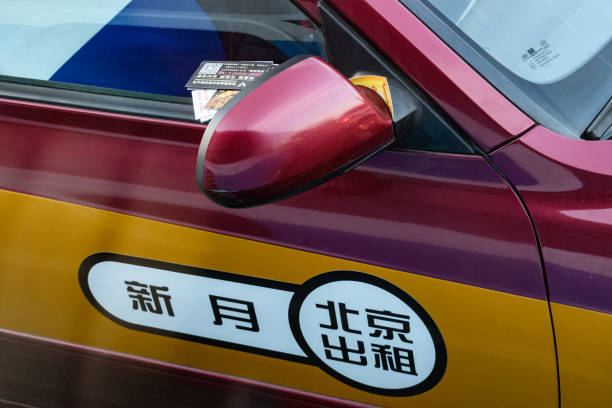
Internet-booked taxis and regular cabs are called by different words
there: the former aren't even "taxis," but "internet cars." Their logos
are different, too. Although, in essence, both services are identical:
taxis. This was another thing I only figured out after several attempts,
frantic sprints through the airport, and translating my problem via my
phone: "I need to call an internet car."
They
say everything in China is dirt cheap. But the cheapest thing of all is
the taxi. I couldn't believe my eyes when I saw the sticker on the
window: 1.20 yuan per kilometer. That's just 14 cents! In Germany, for
comparison, it's about 2.60 euros—almost twenty times more. With prices
that laughable, who even needs a private car in China? Even college
students ride taxis every chance they get. There's an app for it: you
just tap where you want to go, and a list of available taxis pops up
with two numbers: how many minutes until it arrives and how much it
costs. It usually starts from 2-3 minutes. You tap your chosen taxi, and
a window opens with a route map, the car's number, the driver's name and
photo, and buttons to either text or call him. No one ever asks where I
am because my location is pinpointed by GPS with terrifying,
meter-perfect accuracy. I just wait for the taxi with the right number,
loitering on the sidewalk or by the gate, and it pulls up right to me.
It's like something out of a fairy tale. A veritable "taxi communism" in
a single country. Once, returning from a conference very late, my flight
landed in the city that was my base for the Chinese trip.
Internet-booked taxis and regular cabs are called by different words
there: the former aren't even "taxis," but "internet cars." Their logos
are different, too. Although, in essence, both services are identical:
taxis. This was another thing I only figured out after several attempts,
frantic sprints through the airport, and translating my problem via my
phone: "I need to call an internet car."